Hey, it's Pam!
An FDA inspector picks up one of your team's SOPs. Where do their eyes land first? This week I'm looking at how inspectors actually read, and what that means for the way your team writes.
Speaking of readers: PAM, our Professional Authoring Model, rewrites your documents based on readability research and explains why each change works. Want to see what it does with one of your SOPs? Hit reply and I'll set up a demo. |
|
|
|
What your SOP needs to say before step one |
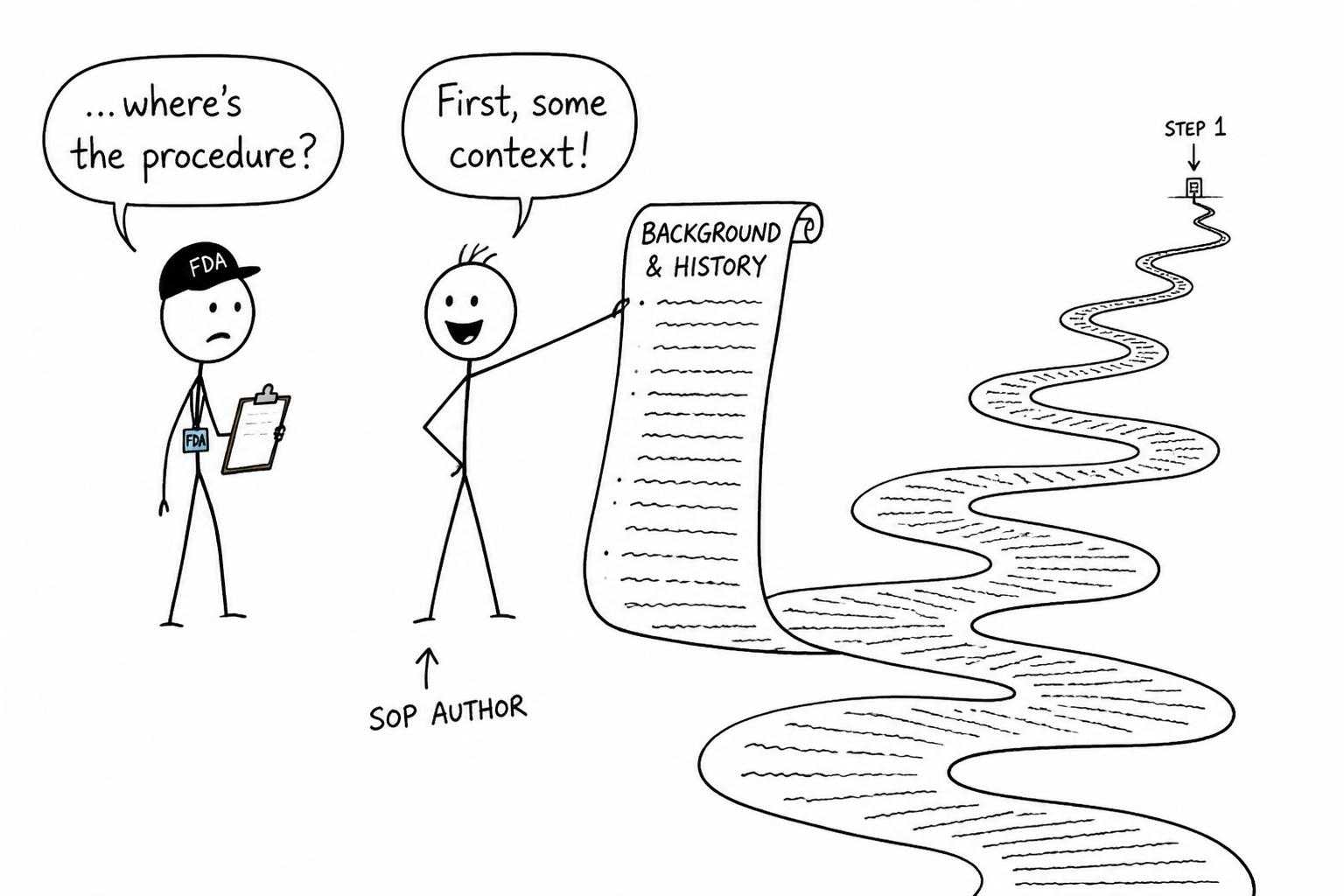
Picture an inspector with a stack of your SOPs and limited time. They'll pick one up, skim the opening, and decide quickly whether it's clear what the procedure covers and who's responsible.
A lot of SOPs make that harder than it needs to be. They open with the history of the procedure: why it was revised, which group used to own it, the background that made sense to the people who wrote it, and the regulations that govern it. While this information belongs in a regulated document, when it comes first, the reader has to dig for the procedure itself.
The same thing happens further down, when requirements get tucked into long paragraphs and an inspector (or an operator on the floor) can't easily find them or tell whether they were met. The fix: Before you draft, answer four questions in plain terms: -
What work has to happen?
- Who does it?
- What triggers it?
- What record shows it's done?
Put those answers up front, and write each requirement so someone can verify it was met. |
|
|
|
What a former FDA investigator saw behind closed doors |
On the latest episode of The Writing Docs, former FDA specialty investigator, scientist, and safety professional Kaneal Oliver Keels takes us inside regulatory reviews and site inspections.
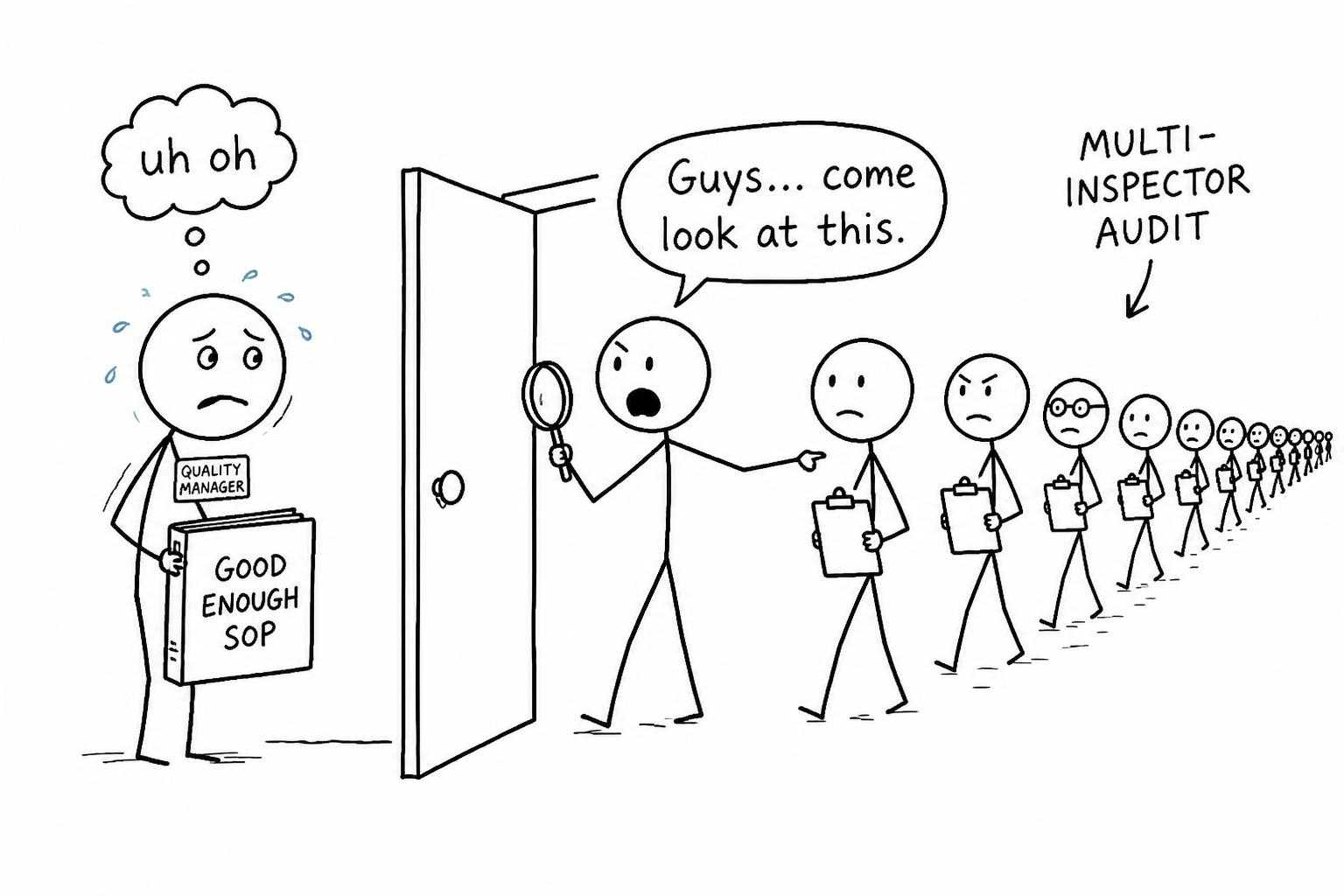
She explains why more than 90% of FDA warning letters trace back to documentation failures instead of bad science, and how settling for "good enough" SOPs can turn an inspection into a multi-inspector audit. She also discusses what an inspector looks at first when opening the reports and SOPs. (Hint: it isn't page one.)
Listen on Podbean or watch on YouTube. If you'd like to know how your own documents would hold up, our PROS Readability Risk Assessment® shows you where the risk is.
Which of your SOPs would you least want an inspector to open first? Hit reply and I'll tell you what we'd look for. |
|
|
|
The impact statement that answered itself twice |
Each issue we show a fictional regulated-industry document alongside our rewrite, so you can see exactly what changed and why. Original
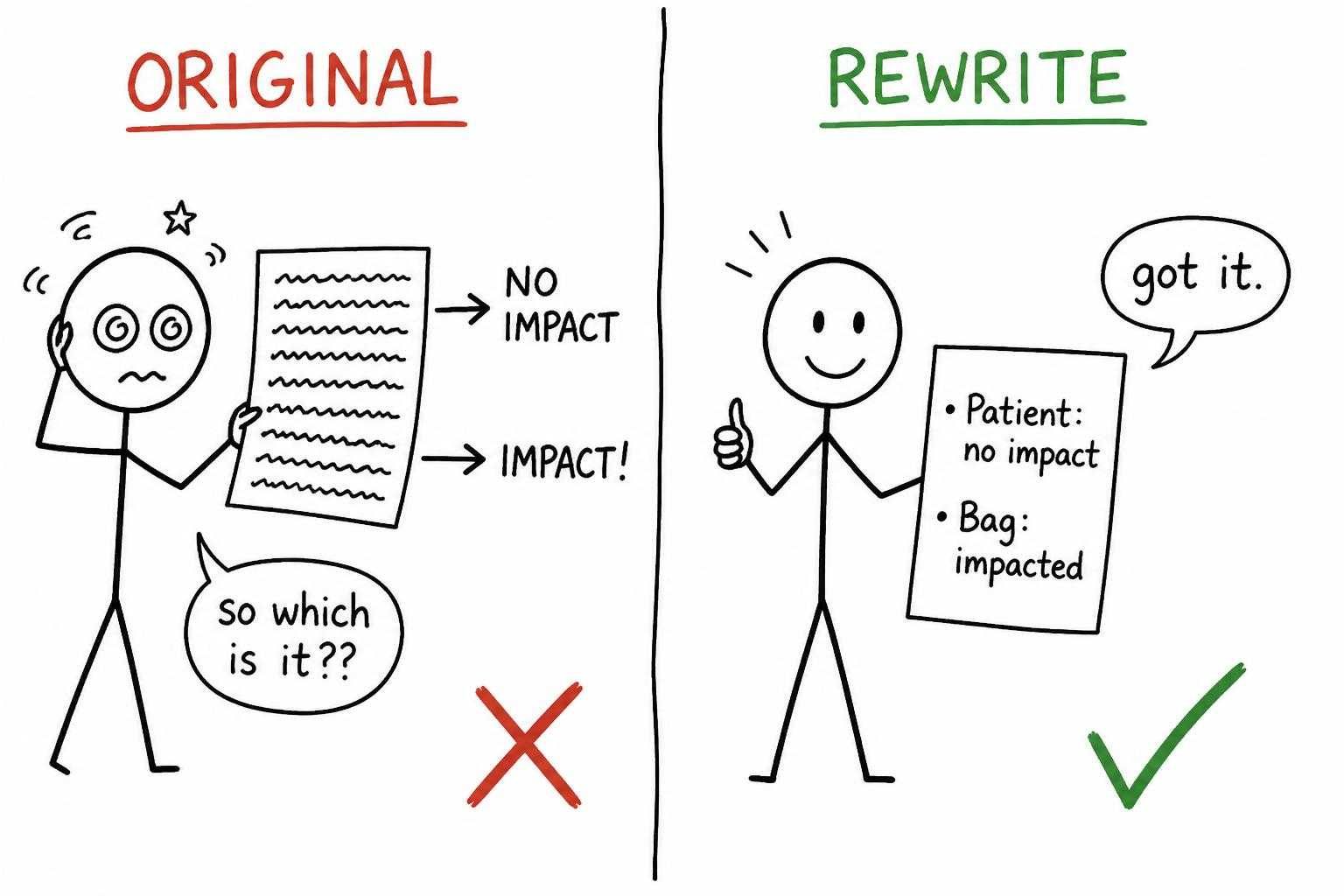
Impact and Risk Analysis: There is no impact since the defect was caught prior to infusion and was not administered to the patient. There was impact to the bag as it was breached and could not be administered to the patient. Investigation Summary and Conclusion: Review of the packout and shipment process did not yield any deficiencies or potential issues that could have led to the cracked bag. Review of the manufacturing, labeling and re-labeling process did not yield any deficiencies or potential issues that could have led to the cracked bag. Review of the clinical site receipt indicated that there were issues with opening the cassette which could have caused the cracked bag. A new cassette with a swing arm closure has been implemented which is expected to mitigate future cracked bags caused by handling and opening the cassette. This is due to the swing arm being much easier to operate than the previous closure.
Rewrite Impact and Risk Analysis - No impact to the patient: breach was caught prior to infusion.
-
Bag impacted: it was breached and could not be administered to the patient.
Investigation Summary and Conclusion Deficiencies or potential issues leading to cracked bag: -
None to packout and shipment and manufacturing and labeling and relabeling processes
- Clinical site receipt: issues opening the cassette, which could have caused the cracked bag
Actions Taken: A new cassette with a swing arm closure has been implemented, which is expected to mitigate cracked bags caused by handling and opening the cassette. Why it works The original says there's no impact and then says there was, so a skimming reader gets two answers in a row. The rewrite separates patient impact from product impact, groups the processes that checked out, and gives the corrective action its own heading so it's easy to find.
|
|
|
|
Thanks for reading!
Don't want to receive these emails? There's an unsubscribe button at the bottom. Copyright © 2026 Hurley Write. All rights reserved.
19701 Bethel Church Rd., Ste 103-144, Cornelius, NC 28031 |
|
|
|
Disclaimer: The documents shown in this newsletter are fictional samples created by Hurley Write for illustrative and educational purposes only. Any names, companies, data, or scenarios depicted are invented and do not represent real clients, organizations, or events. These materials should not be mistaken for, or used as, an actual client's work product. |
|
|
|
|