Hey, it's Pam!
Ask a team how risky its documents are and you'll usually get a shrug. This week I'm looking at why writing quality is easier to measure than most people think, and where it tends to slip without anyone noticing.
New on The Writing Docs: Former FDA director Eric Pittman explains what investigators look for when they read your SOPs and investigation reports, and why defensive language and weak root-cause logic lead to warning letters. Listen to the episode |
|
|
|
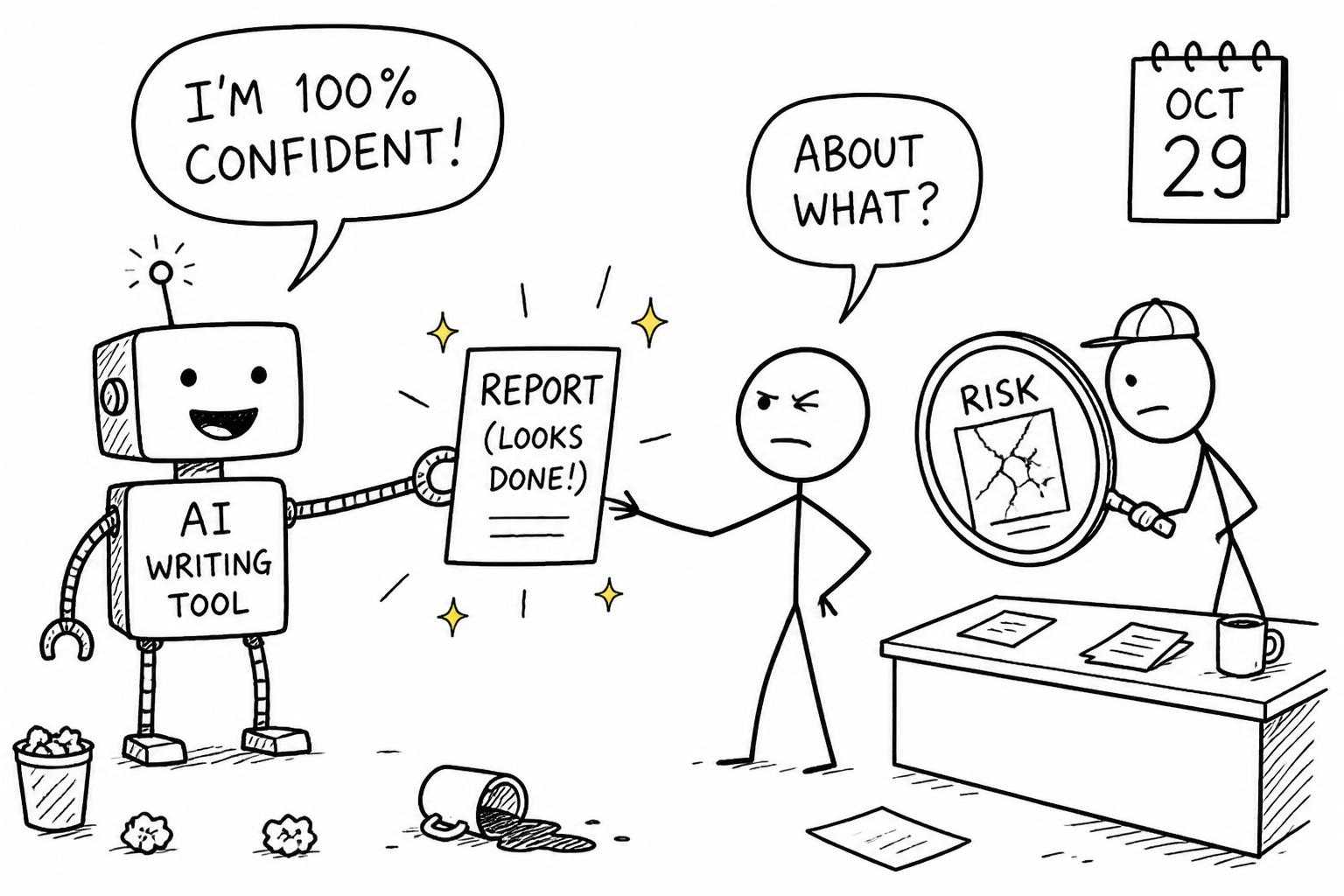
Free live session: AI-Powered Writing Without the Risk |
AI writing tools can make your team faster, or they can quietly weaken the quality, security, and clarity of your documents. The difference comes down to two things: AI training that sticks and a way to measure the risk.
On Thursday, October 29 at 11:00 a.m. ET, we're hosting a free live session for leaders who want their teams using AI efficiently and effectively. You'll learn: - How to choose AI training that goes beyond generic prompts and theory
- The ethical foundations for using AI writing tools well
- How our PROS Readability Risk Assessment® quantifies and reduces writing risk
Is your team already drafting regulated documents with AI? Save your seat, or hit reply and I'll send you the details. |
|
|
|
Writing quality is more measurable than you think |
If someone asked you to prove your team's documents are successful, what would you show them?
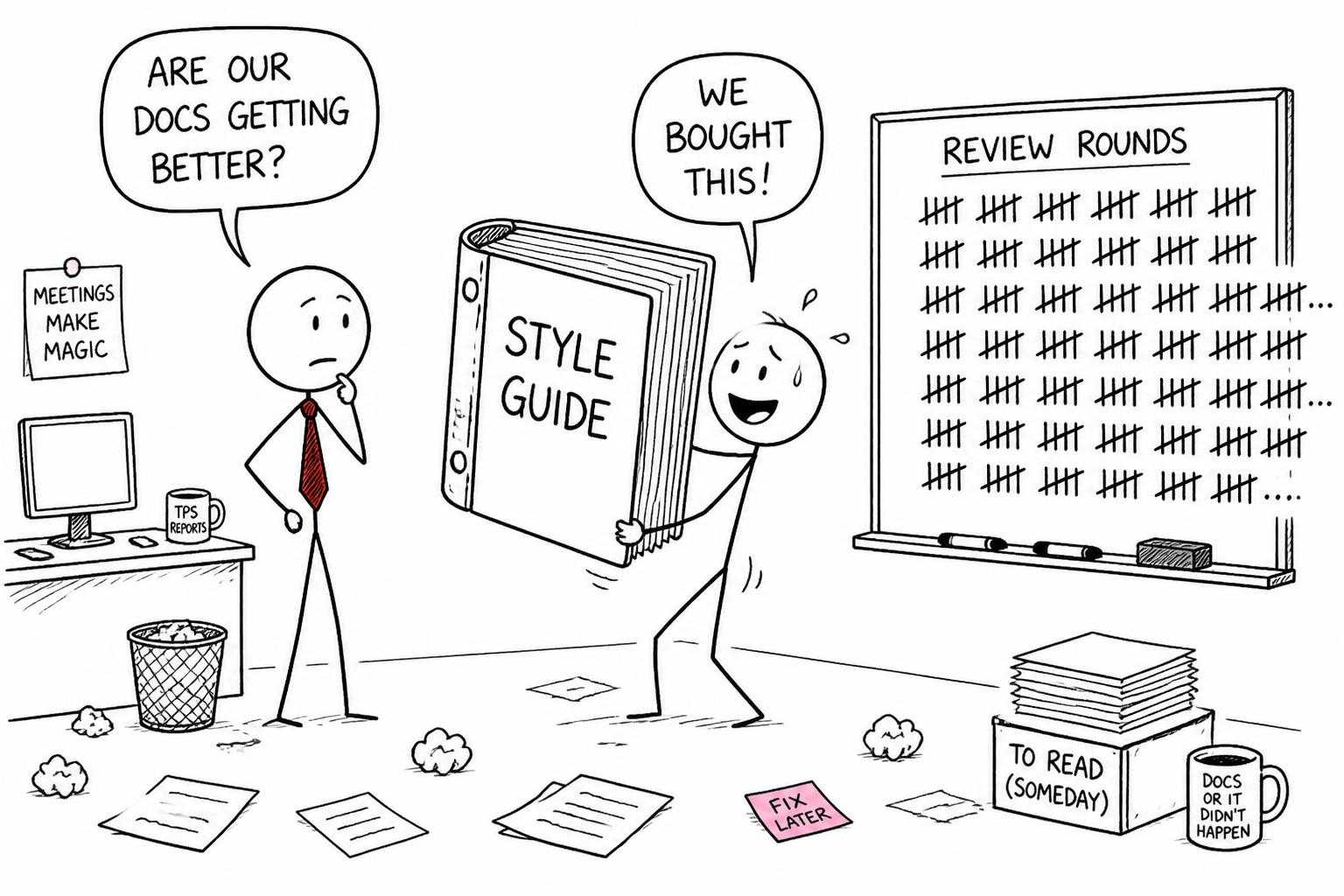
Most managers I talk to point to a style guide or templates. Those are inputs. The outcomes are things that be counted: how many review rounds a report goes through, how long it takes a reviewer to find the key finding, how predictably approvals move, and how often a meeting has to be scheduled to ask what a document meant.
One of the costliest problems those numbers expose is a document that blurs three different things: a fact (the test result), an interpretation (what the result probably means), and a recommendation (what to do next). When those run together, readers can treat an assumption as evidence. AI drafts make this worse, because they state every sentence with the same confidence, even if the author can't support it. The fix: Pick one document type your team writes often and track two things for a month: the number of review rounds and the questions readers send back. This gives you a baseline, and a baseline is where reducing document risk starts. |
|
|
|
The finding that waited until the last sentence |
Each issue we show a fictional regulated-industry document alongside our rewrite, so you can see exactly what changed and why. Original
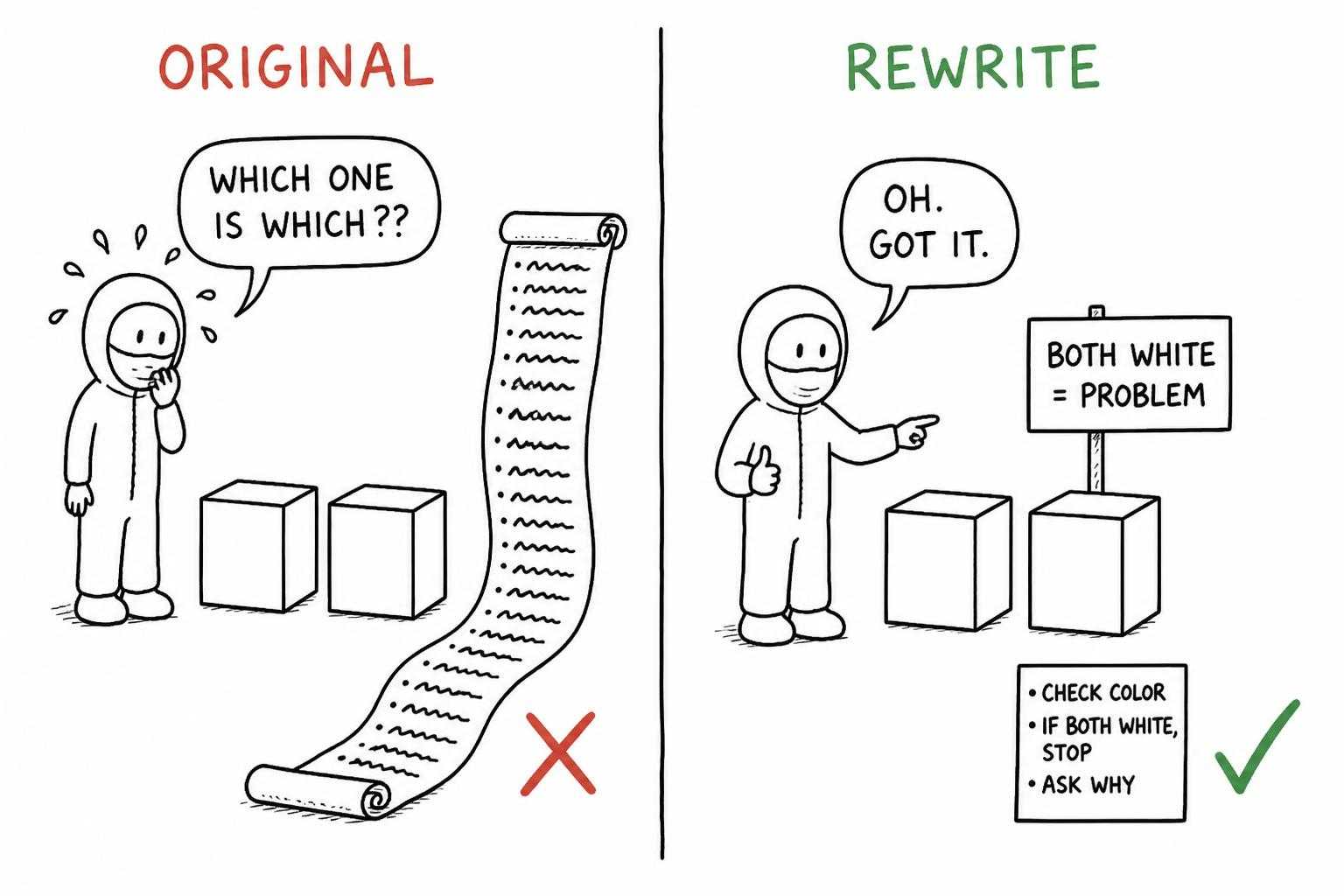
Manufacturing associates who receive materials into the cleanroom document information such as lot number and expiration date, however, disposition status is not something they are trained to focus on. The expectation is that there are checks and balances prior to materials entering the cleanroom to ensure they are appropriate for commercial use. Moreover, the label for "Approved for Specific Use" materials is white and it's not uncommon for Manufacturing associates to receive Conditionally Approved materials for commercial use which are also on white labels. There are no visual cues helping users understand critical information more quickly and efficiently.
Rewrite Manufacturing associates are not trained to focus on disposition status. Additionally, "Approved for Specific Use" and "Conditionally Approved" labels are both white, which prevents these associates from quickly discerning critical information, such as disposition status. Recommendation: - Train manufacturing associates to focus on disposition status.
- Change the label color.
Why it works The original explains why the problem might exist before naming it, and readers treat whatever comes first as most important. The rewrite leads with the two facts that matter, drops the "checks and balances" sentence that adds nothing to the finding, and makes clear why associates can't tell the materials apart. |
|
|
|
Thanks for reading!
Don't want to receive these emails? There's an unsubscribe button at the bottom. Copyright © 2026 Hurley Write. All rights reserved.
19701 Bethel Church Rd., Ste 103-144, Cornelius, NC 28031 |
|
|
|
Disclaimer: The documents shown in this newsletter are fictional samples created by Hurley Write for illustrative and educational purposes only. Any names, companies, data, or scenarios depicted are invented and do not represent real clients, organizations, or events. These materials should not be mistaken for, or used as, an actual client's work product. |
|
|
|
|