Hey, it's Pam!
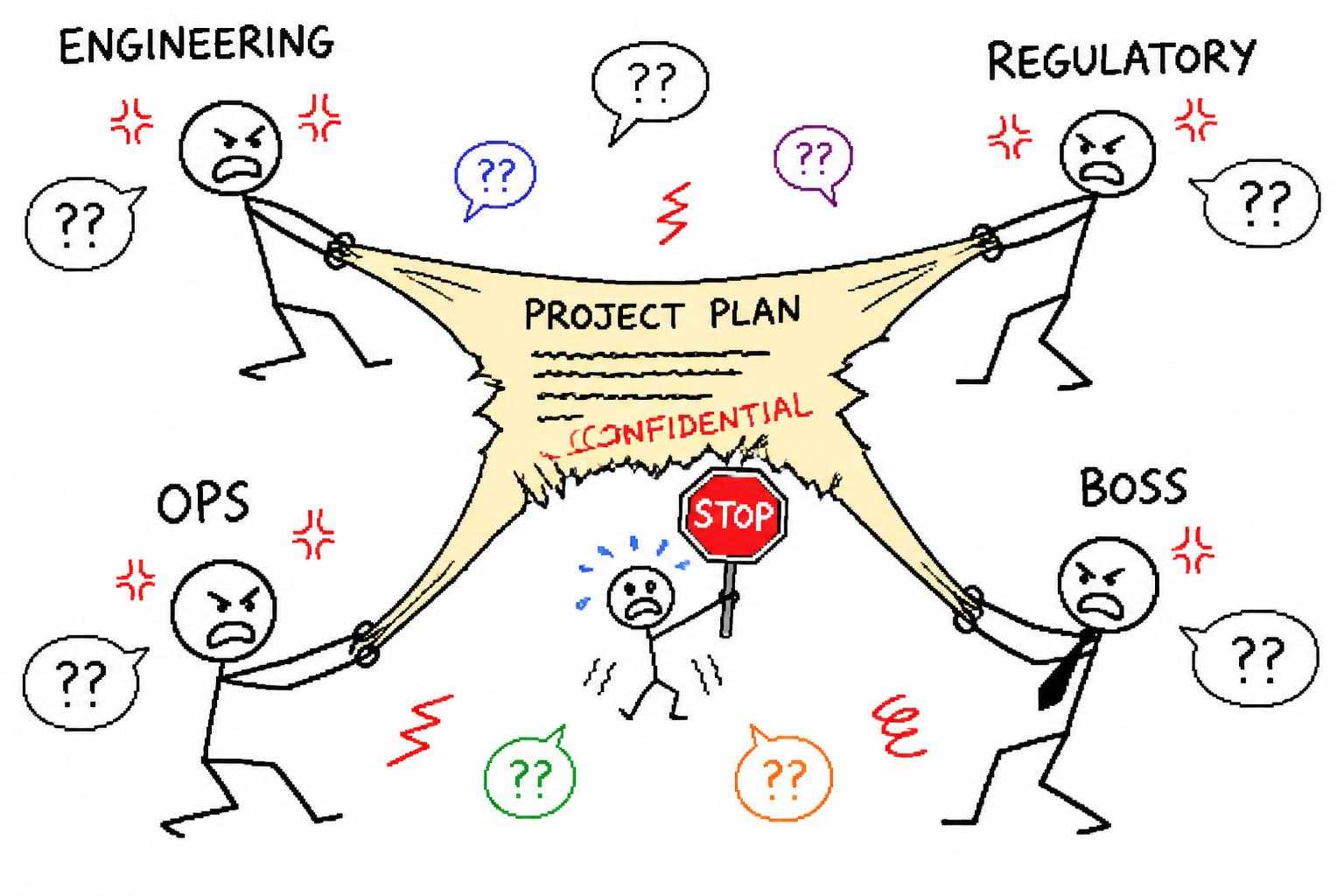
Five reviewers. Five sets of comments. And somehow the document is further from done than when it started. This week I'm looking at why cross-functional documents stall, and what to settle before anyone starts drafting.
One way to settle it: PAM, our Professional Authoring Model, asks three questions before it touches your draft. Who's your reader? What should they walk away with? How do you know if the document is successful? Then it rewrites based on readability research and shows you why each change works. Want to see it on one of your documents? Hit reply. |
|
|
|
Why cross-functional documents get stuck in review |
I see this a lot with documents that pass through several functions before they're final. The content can be technically correct, but the document gets stuck in review.
Part of the reason is that each group reads the draft with different priorities. An engineer may be checking that every technical detail is exact, while someone in regulatory is looking for a clear trail back to the data, and the operations team mostly wants to know whether they can follow it on the floor. They're all reviewing the same document, but because there are no standards in place, no guiding principles, the document stalls or, worse, comes back with feedback that doesn't enhance the value of the document for the intended reader.
The comments start to pile up as a result. One reviewer asks for more background and another wants it shorter, while someone else rewrites sentences without explaining what reader need or risk the change is meant to address. The author ends up trying to reconcile all of it. In just about all cases that we see, the team has no agreement (or, at best, a fuzzy idea), of what the document is supposed to accomplish. While on the surface it might be meant to record a process, get an approval, guide the work, or explain a deviation, the team has to understand who's reading it and why. A successful document appeals to its readers and guides them to the conclusion.
The fix: Before drafting, brainstorm: who is the primary reader and what do you know or need to know about them, including reading style? (Believe it or not, most readers do not read documents in their entirety). What is the document supposed to accomplish? What's the conclusion you want the reader to draw? After figuring out those things, you should be able to start drafting. Sorting all of this out early makes writing it much easier and should result in fewer rounds of review.
|
|
|
|
Last call: Why SOP readability and usability matter |
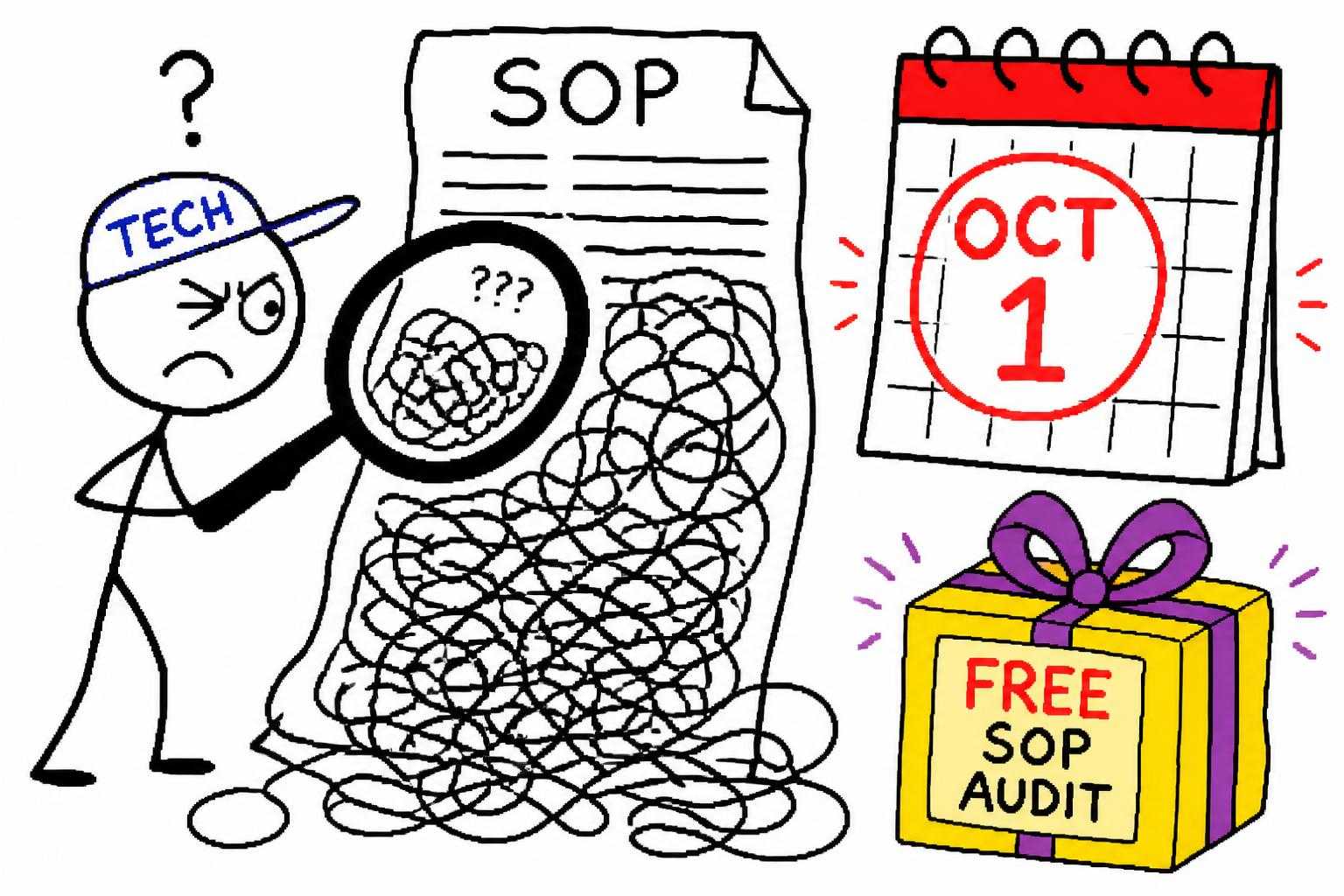
Next Wednesday, October 1 at 12:00 noon EDT, we're hosting a free 45-minute virtual webinar: "Why SOP Readability and Usability Matter."
Your SOPs may look fine on the surface. But unclear instructions, inconsistent reviews, and ineffective templates create risks that stay hidden until a mistake, delay, or audit brings them to light. We'll talk about these issues and how to avoid them. Register: https://us02web.zoom.us/meeting/register/vHc1i2_CQTWJ5VaN0elpGw Speaker: MJ Hurley, MA And we're giving away a free SOP audit! If your SOPs could use a second look, save your seat below. |
|
|
|
The conclusion that took too long to conclude |
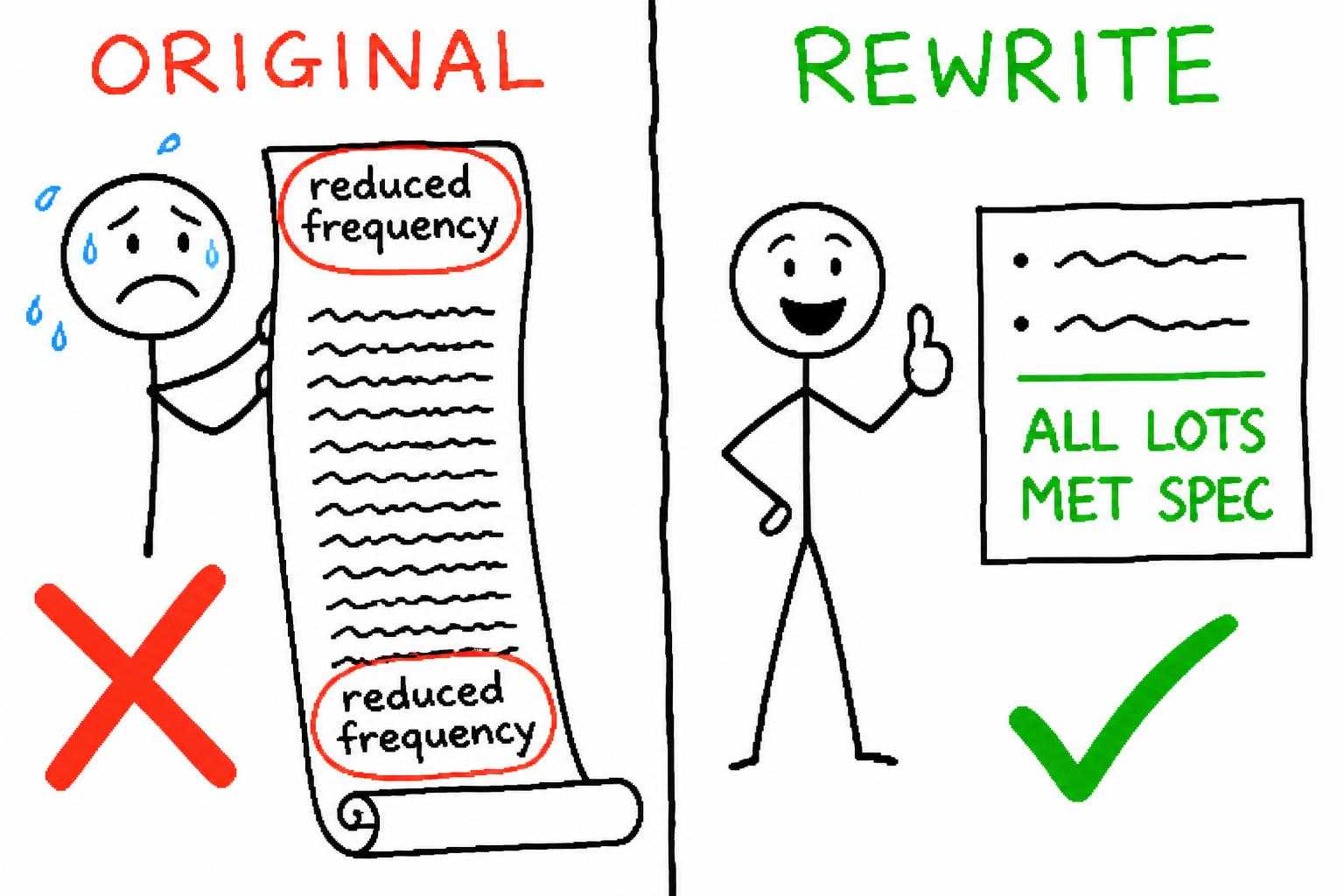
Each issue we show a fictional regulated-industry document alongside our rewrite, so you can see exactly what changed and why. Original
CONCLUSION: We have determined that a reduced testing frequency can be implemented for raw material. This decision is based on supporting evidence that the attributes tested on XYZ have minimal changes over a time period of up to 123 years. All data evaluated over this period for each lot was found to be meeting specification for each test. The results generated are consistent and well within specification, which confirms that XYZ can be tested at a reduced frequency. Rewrite CONCLUSION: Raw material can be tested less frequently because XYZ had minimal changes over a period of up to 123 years in attributes, including assay, cis/trans isomer ratio, and total impurities (both specified and unspecified individual impurities). All data evaluated for each lot met specifications for each test. Why it works
The original takes too long to get to the point, and its last sentence repeats the first. Does it matter that "we" determined this or simply that it was determined? The rewrite combines the choppy sentences so the decision and its basis land in one, and names the attributes tested so "minimal changes" means something specific. The key fact, that every lot met specifications, gets its own one-sentence paragraph for emphasis. (One-sentence paragraphs are perfectly fine, and they're a strategic way to make a point stand out.)
|
|
|
|
Thanks for reading!
Don't want to receive these emails? There's an unsubscribe button at the bottom. |
Copyright © 2026 Hurley Write. All rights reserved.
19701 Bethel Church Rd., Ste 103-144, Cornelius, NC 28031 |
|
|
|
Disclaimer: The documents shown in this newsletter are fictional samples created by Hurley Write for illustrative and educational purposes only. Any names, companies, data, or scenarios depicted are invented and do not represent real clients, organizations, or events. These materials should not be mistaken for, or used as, an actual client's work product. |
|
|
|
|