Hey, it's Pam
This week is about a quiet clarity killer: writing that never says who does what. It's a common reason documents have to be rewritten. Understand when to include the user (and when it's unnecessary) reduces review times and enhances clarity.
Got a writing or review headache you want me to tackle in a future issue? Just hit reply and tell me what issues you're seeing. I read every response, and they shape what comes next. In this issue: - Why "it was determined" is a no-go
- How to escape review hell
-
The good, the bad, the ugly: Copy Makeovers
|
|
|
|
Why "it was determined" is a no-go |
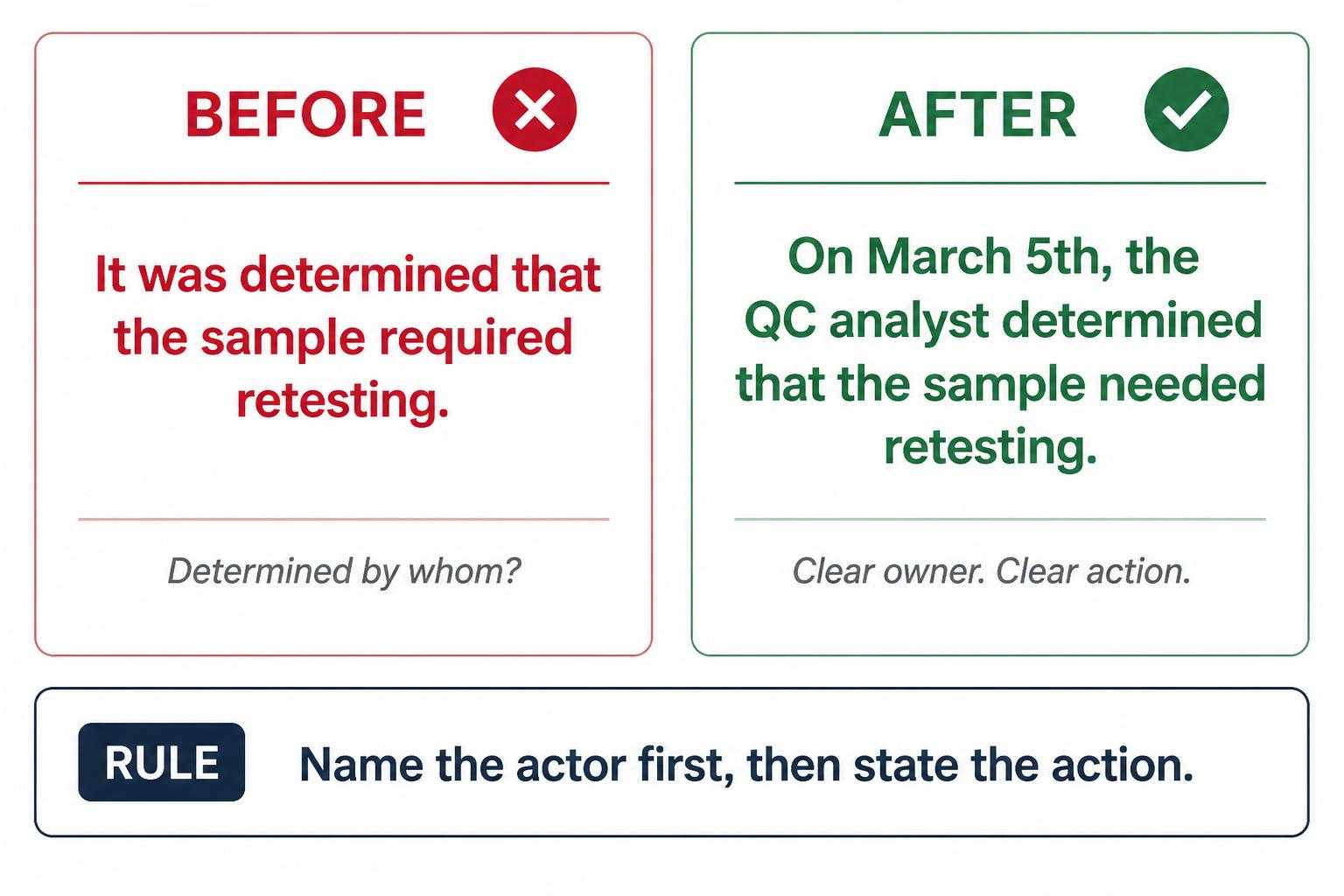
Here's a pattern I see a lot in regulated writing. A sentence describes an action but not who took it. "It was determined that the sample required retesting." Determined by whom? Retested by whom? In a regulated document, a missing owner could be a missing control. Passive, ownerless writing feels safe. It sounds formal and careful. After all, maybe we don't know who completed the action and maybe it's unimportant. Both are fair points.
But understanding when to name the actor is key. If the reader needs to know who or what completed the action, passive voice won't do. But if it doesn't matter who completed the action, passive works fine. The problem is that passive writing is often used by default; the writer doesn't consider if the actor needs to be named. The fix is simple. If the actor is important, name the actor, then state the action: - "On March 5th, the QC analyst determined that the sample needed retesting."
- Save passive voice for when the action is more important than the actor.
Clear ownership reads faster and clears review faster. |
|
|
|
Most teams treat slow reviews and confusing documents as a skills' problem. More often, however, the system is what's broken. Communication runs on three things working together: writers, reviewers, and the tools they share. When one breaks, the whole system stalls.
That's what our patented PROS Readability Risk Assessment finds. We align on your goals, analyze your documents and review process, dig into your SOPs and templates, and interview the people doing the work. You get a PROS Roadmap: the root causes, plus exact, ready-to-use fixes. We've showed teams how to reduce reviewing time by 30 to 40 percent and how to save hundreds of thousands of dollar a month. Want to see where your process is leaking time? |
|
|
|
The Good, the Bad, and the Ugly: Copy Makeovers |
Each issue, we create a sample of regulated-industry writing and show how a few changes make it clearer. Original
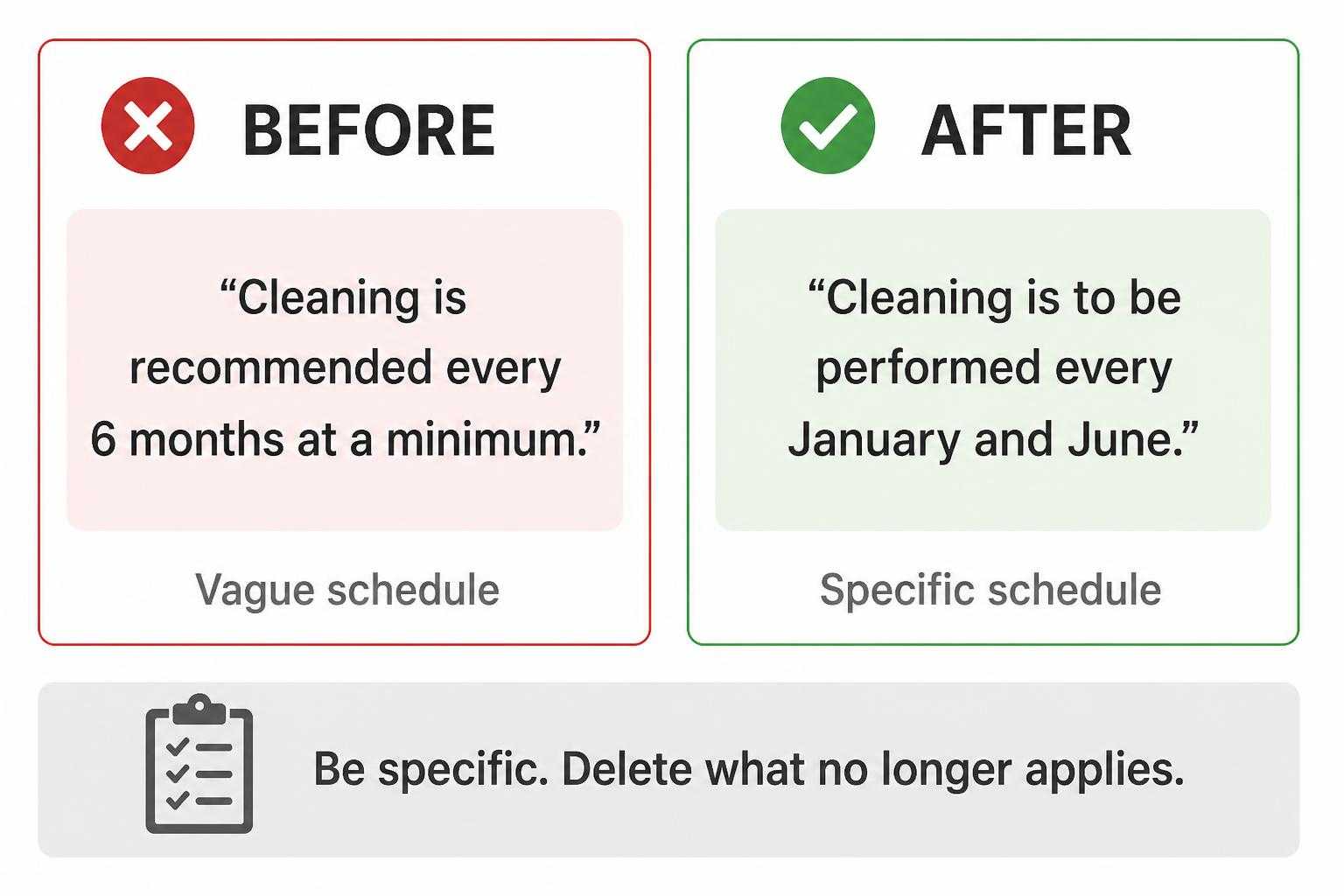
Investigation in all the aforementioned missed cleaning entries found that the language used in the SOP-1 to outline routine cleaning is poorly worded. SOP-1 states that cleaning is "recommended every 6 months at a minimum." This is deemed to be not sufficiently specific.
Furthermore, there is a direction for the analyst to coordinate with IT to disable alarms during cleaning. Recent communications with the administrator revealed that this is not the current practice. Rewrite Overview SOP-1 cleaning entries are unclear and incorrect: - how often the cleaning should be performed should specially state every January and June
- IT does not need to be contacted to disable alarms during cleaning.
Recommendations
- Rewrite SOP-1 to state that cleaning is done every January and June.
- Delete the requirement to coordinate with IT to disable alarms.
Why it works
The original is redundant and vague. "Poorly worded" and "not sufficiently specific" say the same thing, and "aforementioned" is legalese. It also states the problem, then the reason, then the fix, an order that buries the point. The rewrite uses bullets to draw the eye, keeps the same keywords, uses headings to help readers find information, cuts the redundancy, swaps in a real cleaning schedule, and ends with clear recommendations.
|
|
|
|
Thanks for reading!
Don't want to receive these emails? There's an unsubscribe button at the bottom. Copyright © 2026 Hurley Write. All rights reserved.
19701 Bethel Church Rd., Ste 103-144, Cornelius, NC 28031 |
|
|
|
Disclaimer: The documents shown in this newsletter are fictional samples created by Hurley Write for illustrative and educational purposes only. Any names, companies, data, or scenarios depicted are invented and do not represent real clients, organizations, or events. These materials should not be mistaken for, or used as, an actual client's work product. |
|
|
|
|